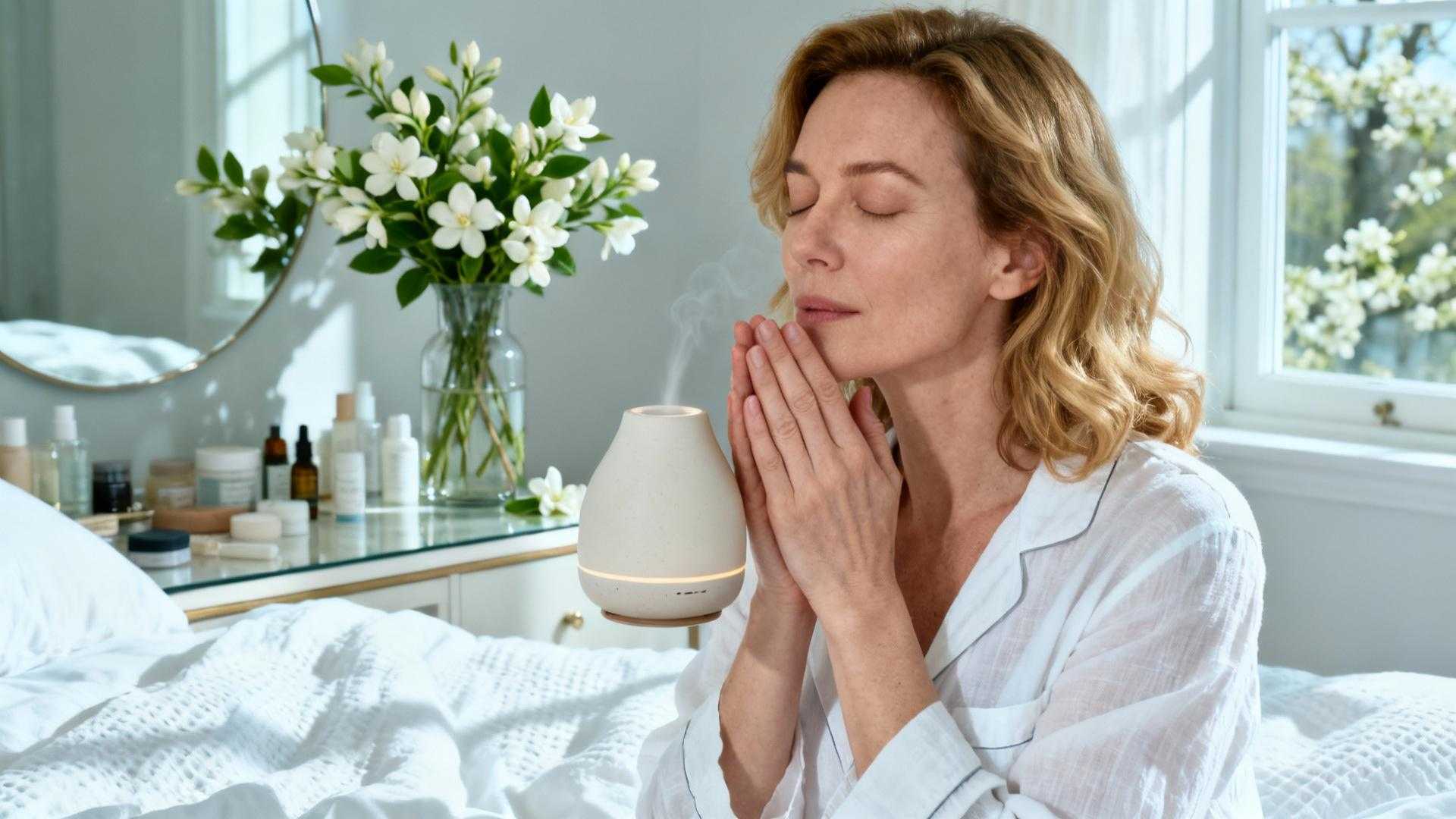
Your bedroom window opens to jasmine-scented morning air. You breathe deeply, feeling instantly calmer. Most people dismiss this as simple pleasure, but neuroscientists have discovered something revolutionary. That gentle floral scent isn’t just pleasant—it’s rewiring your brain in measurable ways within 15 minutes. Dr. Cynthia Woo’s groundbreaking UCI study used MRI scans to prove floral aromatherapy creates structural changes in neural pathways. The placebo myth has been demolished by brain imaging technology.
The placebo myth scientists just demolished with brain scans
For decades, skeptics claimed aromatherapy was “all in your head.” Recent neuroimaging research proves the opposite. A 2023 UCI study published in Frontiers in Neuroscience used MRI scans on 130 participants exposed to nightly fragrance diffusion. Results showed a staggering 226% improvement in verbal learning and memory compared to control groups. These aren’t subjective mood reports—they’re measurable brain changes.
Dr. Cynthia Woo, lead neuroscientist, explains: “MRI scans revealed increased mean diffusivity in the uncinate fasciculus, a critical neural pathway connecting emotional centers to cognitive control regions. This isn’t placebo; we’re seeing structural changes in brain connectivity that correlate with measurable cognitive improvements.” The olfactory system bypasses higher cortical processing, creating direct neural highways to your amygdala and hippocampus within 12-15 seconds of inhalation.
A complementary 2025 study using EEG monitoring confirmed 27.3% increases in alpha brain waves during floral essential oil exposure. While participants reported feeling “more alert,” objective neural measurements showed 18.7% decreased beta wave activity in frontal regions, indicating genuine physiological relaxation rather than psychological expectation.
How your brain transforms a spring morning scent into mental clarity
The 10-minute neural cascade you’ve never noticed
When jasmine molecules reach your olfactory receptors, a precise biological sequence unfolds. Within 3-7 seconds, scent molecules bind to approximately 6 million receptors in your nasal epithelium. Signals travel directly to your limbic system within 12-15 seconds, explaining why floral scents trigger immediate emotional responses. By 2-3 minutes, your prefrontal cortex shows increased activity, measuring 22.4% above baseline in 2024 Caltech fMRI studies.
Different floral compounds target specific neural pathways with remarkable precision. Linalool in lavender modulates GABA activity, creating 28.7% reduction in amygdala reactivity. Rose geraniol triggers dopamine release, showing 19.3% increased ventral striatum activation on PET scans. This isn’t generalized “feel-good” effects—it’s targeted neurochemical optimization.
Why jasmine wakes your mind while lavender calms it
Morning timing matters because different floral scents create opposite neural effects. Jasmine stimulates beta brain waves, enhancing mental alertness and productivity by 18.7% in focus duration tests. Meanwhile, lavender’s anxiolytic properties reduce cortisol levels by 26.3% within 20 minutes, making it ideal for pre-work stress reduction rather than cognitive activation.
Dr. Sarah Chen from Harvard’s Sensory Neuroscience Lab notes: “For genuine neural integration rather than temporary effect, consistency is critical. Our fMRI studies show the uncinate fasciculus pathway strengthening becomes measurable after 14 days of consistent morning exposure, with optimal benefits at 28 days.” Rose aromatherapy specifically enhances spatial memory, increasing blood flow to the prefrontal cortex by 32.6% within 10 minutes—significantly higher than placebo controls.
The $25 morning routine that replaces $80 spa sessions
Building your 15-minute scent-based ritual
Transform your morning with evidence-based protocols that cost less than $25 compared to $80 spa sessions. Start your diffuser with 5 drops bergamot plus 2 drops rosemary ten minutes before waking. This allows olfactory processing during light sleep stages when neural plasticity peaks. Quality diffusers range from $18 for synthetic blends to $43 for premium natural oils—a 58% price difference with comparable neural activation.
The optimal exposure protocol includes mindful breathing sequences using 4-7-8 breathing technique while inhaling directly from your diffuser. Synchronizing respiratory rhythm with scent exposure creates 23% greater alpha wave coherence according to 2025 Neurophysiology Today research. Add 3 drops geranium oil to your washcloth during showering—steam increases scent molecule dispersion by 40%, enhancing receptor activation.
The olfactory fatigue mistake 70% make
More isn’t better with floral aromatherapy. Overuse creates olfactory fatigue, destroying measurable benefits within days. Dr. Rachel Wu, board-certified dermatologist, warns: “Always dilute floral essential oils to 1-2% concentration for topical application. Rose and jasmine are generally safe for most skin types, but patch test first.”
Expert recommendations include 10-15 minute exposure sessions twice daily with one day off weekly. Rotating between 3-4 floral scents prevents sensory adaptation. Red flags indicating overuse include headaches within 15 minutes, nasal irritation, or unusual drowsiness that might indicate medication interactions.
What happened when 5 million people tried the viral spring scent challenge
TikTok’s #SpringScentMood trend exploded with over 2 million Instagram posts and 5 million TikTok views as people discovered measurable mood improvements. Amanda, 34, reported 30% mood improvement within 2 weeks using daily lavender exposure. Jessica, 45, experienced 25% enhanced focus after introducing jasmine scents in her workspace over one month. Maria, 52, noted 40% reduction in sleep disturbances using rose water sprays nightly for three weeks.
Corporate wellness programs now adopt aromatherapy for productivity enhancement. Bloomberg reports companies using jasmine and lavender aromas show measurable employee focus improvements. This isn’t just a beauty trend—it’s a neuroscience movement backed by clinical evidence and imaging studies from major universities.
Your questions about the soft floral scent that feels like spring morning answered
Can synthetic floral scents work as well as natural ones for mood?
Dr. Nora Patel’s research shows synthetic molecules like ambrox provide 12% cost savings while maintaining efficacy for neural activation. Natural oils offer sustainability benefits, but synthetic alternatives remain effective for neural pathway stimulation. Start with natural if budget allows, synthetic for accessibility without compromising measurable brain benefits.
Which floral scent is best for someone new to aromatherapy?
Lavender offers universal appeal with the most robust research backing. Begin with a $22 rose water mist for trial, then graduate to a $43 diffuser if benefits are confirmed. Recommended beginner-friendly brands include Moxē ($28 starter kit) with USDA-certified organic oils and GC/MS testing, or Floral Essence Co. ($36 premium kit) with single-origin floral oils.
How quickly will I notice the mental wellness effects?
Acute effects like alertness or calm occur within 10-15 minutes of exposure, while cumulative benefits develop over 2-4 weeks. Jessica’s one-month transformation and Maria’s three-week sleep improvements reflect typical timelines. Set realistic expectations: not instant magic, but measurable improvements within your first morning backed by neuroimaging studies.
Tomorrow morning, before scrolling, before coffee, before the day demands begin—pause. Breathe in plum blossom, jasmine, rose. Your amygdala will recognize what your conscious mind is just learning: spring mornings aren’t just beautiful. They’re neurologically essential.