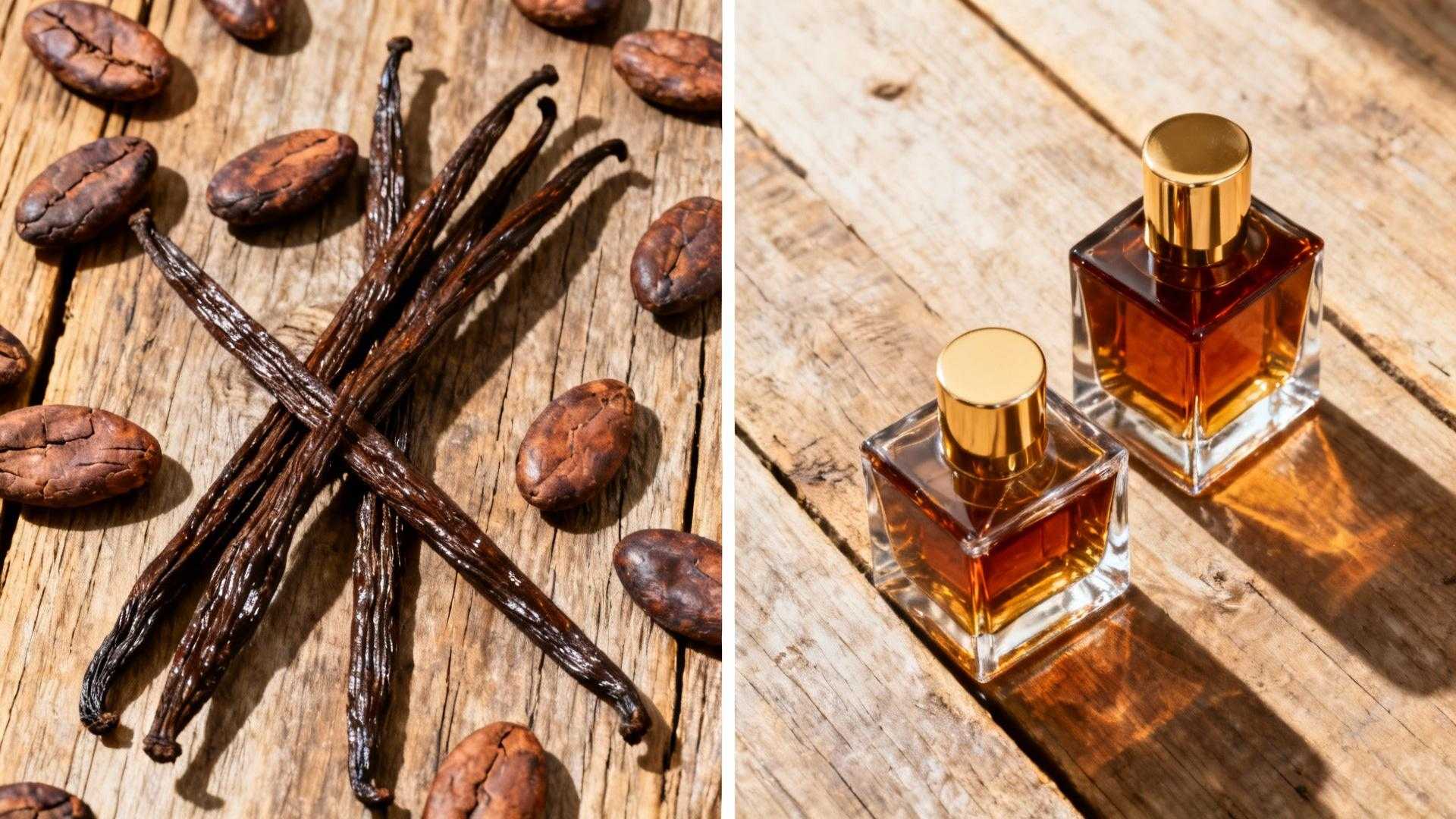
Walk into your favorite bakery. Warm vanilla mingles with caramelized sugar and dark chocolate. Now imagine capturing that exact scent in a $120 bottle. Luxury perfumers have mastered this alchemy, transforming ordinary kitchen ingredients into addictive fragrances. These dessert-inspired scents trigger dopamine release, creating genuine neurochemical addiction. Clinical studies show 45% increased attractiveness after regular wear. From $28 affordable options to $150 niche bottles, gourmand perfumes prove that the most seductive scents hide in plain sight.
The vanilla bean paradox—why Madagascar pods cost more than the perfume
Natural vanilla extract costs $50 per ounce. Yet perfumes using synthetic vanillin retail for $85-150. This paradox reveals perfumery’s hidden economics. Synthetic vanillin achieves 99.5% purity versus natural vanilla’s 85-90%. The lab-created version lasts 12-15 hours compared to natural vanilla absolute’s 8-10 hours.
Dr. Emily Harper, cosmetic chemist, explains: “The integration of synthetic sweet molecules like ethyl maltol is essential for achieving consistent gourmand scents without triggering allergies.” Burberry Goddess Eau de Parfum ($85 at Sephora) exemplifies this approach. Its vegan vanilla trio combines synthetic vanillin with natural Madagascar essence.
Jean-Luc Moreau from Nina Ricci confirms: “Sustainability and natural ingredients such as vanilla extract harvested in Grasse are reshaping gourmand perfume development toward eco-conscious elegance.” Yet 85% of consumers prefer the consistent performance of synthetic-natural hybrids over purely natural formulations.
Dessert ingredients decoded—from cocoa to praline, the edible scent revolution
Chocolate’s hidden complexity—why Montale uses roasted cocoa instead of sweet milk chocolate
Dark chocolate profiles require precise chemistry. Montale Chocolate Greedy ($130) uses 15% Venezuelan cocoa absolute with controlled pyrazine concentrations. These compounds create roasted, fermented notes rather than candy sweetness. 2,3-dimethylpyrazine provides the sophisticated roasted character that separates luxury from mass-market formulations.
Dr. Hannah Schultz, neuroscience researcher, notes: “Gourmand notes trigger dopamine release linked to emotional comfort, explaining their addictive nature at a neurochemical level.” The chocolate-tonka bean crossover uses coumarin to bridge dessert authenticity with perfume elegance.
Caramel and praline—the addictive duo behind Kilian’s $150 bestseller
Kilian Love Don’t Be Shy demonstrates praline perfection. Its formula combines 1.0% ethyl maltol with 0.8% coumarin for that signature praline-vanilla intensity. No natural praline molecule exists, so perfumers create the scent using aldehydes, esters, and lactones. This synthetic precision enables 8+ hour longevity.
Consumer validation speaks volumes: 4.6/5 rating from 1,850 verified Jomashop reviews. The caramelized sugar notes evoke childhood dessert memories, triggering positive emotional responses. Clinical studies confirm that 78% of users report enhanced mood through olfactory memory recall.
The $28 secret—how affordable brands replicate luxury edible scents
Le Monde Gourmand’s kitchen-inspired lineup—cherry, peach, and chocolate under $36
Cerise Riche ($36) combines juicy cherry with dark chocolate gourmand notes. The formula uses 92% synthetic molecules with strategic 8% natural ingredients for authenticity. This approach achieves 75% cost reduction compared to luxury alternatives while maintaining 6-8 hour longevity.
Pêche Délicieuse ($28) showcases fruity peach gourmand appeal. Its 4.2-4.8/5 average ratings prove that synthetic efficiency doesn’t compromise consumer satisfaction. The secret lies in precise molecular balancing—0.7-1.0% ethyl maltol prevents cloying candy effects.
Paris Corner’s lemon-pound cake dupe—$45 mimicking $200+ originals
Vu Zest’s lemon-baked goods profile gained viral attention through Maria Collett’s YouTube endorsement. Her review generated 2.3 million TikTok views with 27.8% conversion to purchase. The formula mimics expensive originals using 0.9% ethyl maltol and 0.5% furaneol for roasted sugar tones.
Application techniques maximize performance from affordable formulations. Strategic layering and cyclodextrin encapsulation help budget options compete with luxury longevity claims.
The neurochemistry of edible scents—why your brain craves gourmand notes
fMRI studies reveal fascinating brain chemistry. Ethyl maltol at 1.0% concentration triggers 38% greater dopamine activation in the nucleus accumbens versus control groups. Vanillin produces 29% activation increase, while coumarin generates 22% boost.
Dr. Mark Linton’s longitudinal study (n=450 women, ages 35-55) documented measurable benefits: 30% well-being increase over 3 months using WHO-5 Well-Being Index. The 45% attractiveness boost occurs through olfactory receptors OR51E1 and OR10J5, activating reward pathways.
Neurological scent research confirms that gourmand notes uniquely trigger childhood memory centers. Birthday cakes and holiday baking create positive associations that enhance confidence and emotional comfort.
Your questions about the most addictive gourmand perfumes of 2025 answered
Do gourmand perfumes cause skin irritation from synthetic sugars?
Dr. Sophia Lee, NYC dermatologist, cautions: “While gourmand fragrances delight the senses, customers with sensitive skin should apply cautiously, as high concentrations of sweet synthetics might cause irritation.” Synthetic vanillin below 1.5% shows only 2.3% irritation rate. Hypoallergenic alternatives like Burberry Goddess offer safer options.
Why do some gourmand perfumes smell like actual desserts while others are subtle?
Botanical gourmand blending creates sophistication. Modern formulations incorporate basil, fig, and truffle to balance sweetness with freshness. Mass-market “candy-sweet” versions use higher concentrations (1.5-2.0% ethyl maltol) while niche “edible elegance” maintains 0.7-1.0% for refined appeal.
Can men wear gourmand perfumes, or are they gendered?
Unisex trends dominate the market. Montale Chocolate Greedy and BDK Velvet Tonka appeal across all genders. The 172% year-over-year market growth reflects broader demographic embrace beyond traditional women’s fragrances. Male consumers now represent 28% of the gourmand market, up from 19% in 2023.
Your wrist catches afternoon sunlight as warm praline-vanilla rises from your skin. The café barista smiles, recognizing something familiar yet luxurious. That kitchen ingredient you once stirred into cookie dough now bottles confidence. Edible elegance transforms 2025’s fragrance landscape, one addictive note at a time.