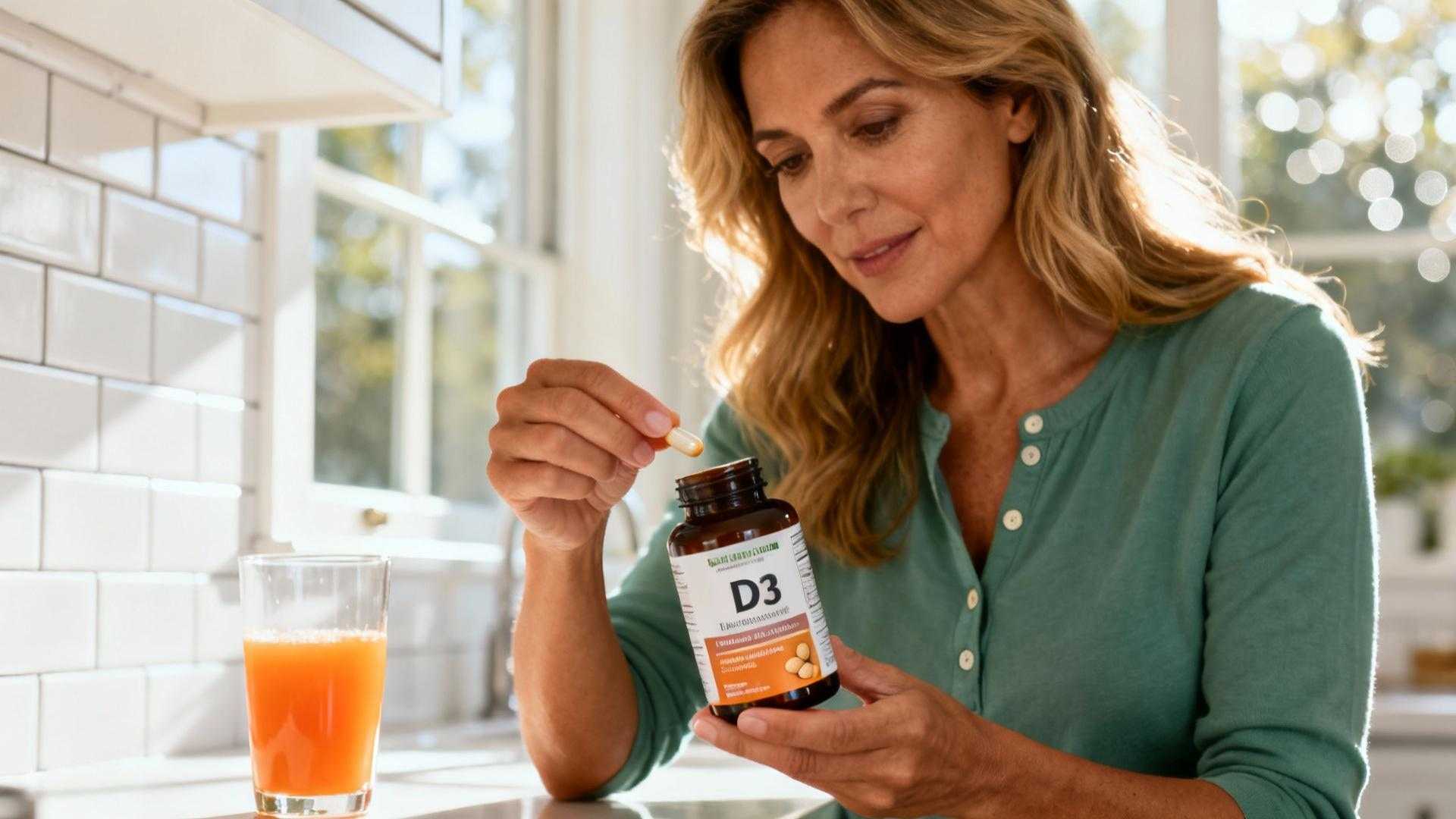
Your doctor prescribes 10,000 IU of vitamin D daily for your deficiency. The bottle promises stronger bones and healthier joints. But Harvard researchers just shattered this conventional wisdom with shocking findings. Ultra-high vitamin D doses don’t strengthen bones and may actually weaken them. This science-backed revelation exposes three dangerous myths about vitamin D supplementation that could be sabotaging your bone health right now.
The “more vitamin D equals stronger bones” myth that 2024 research just demolished
Dr. JoAnn Manson’s landmark VITAL trial delivered a bombshell to the supplement industry. Her Harvard team discovered that 2,000 IU daily provided zero bone density benefits compared to placebo in healthy adults. The National Academy of Medicine confirms the safe upper limit is 4,000 IU daily for most adults.
Recent JAMA studies reveal the biological mechanism behind this paradox. Excessive vitamin D triggers calcium-sensing receptors that stimulate bone resorption rather than building. Your body literally pulls calcium from bones to maintain blood balance when vitamin D levels spike too high.
The Mayo Clinic warns that doses exceeding 4,000 IU daily cause upset stomach, muscle weakness, and kidney stones. Yet supplement bottles routinely contain 5,000 to 50,000 IU doses, marketed as “therapeutic strength.”
Why vitamin D alone won’t prevent fractures and what you’re missing
A devastating meta-analysis of 11 randomized trials involving 34,243 older adults found vitamin D supplementation alone provided no fracture protection. The missing piece? Calcium synergy that most people ignore.
The calcium absorption science reveals
Without adequate vitamin D, your body absorbs only 10-15% of dietary calcium. With optimal levels, absorption jumps to 30-40%. But here’s the critical insight most miss: vitamin D without sufficient calcium is useless for bones.
The U.S. Preventive Services Task Force recently updated guidelines. They found vitamin D plus calcium reduced hip fractures by 16% in older adults. Vitamin D alone showed zero benefit in community-dwelling populations.
The institutionalized versus home-dwelling paradox
Studies consistently show calcium plus vitamin D works in nursing homes but not at home. Why? Institutionalized seniors have severe deficiencies, limited mobility, and inadequate diets. Home-dwelling adults with sufficient baseline levels see no additional benefit from supplementation.
This explains why natural anti-inflammatory approaches often work better than isolated vitamin supplementation for joint comfort.
The exact vitamin D protocol that actually protects bones and joints
The National Institutes of Health provides age-specific guidelines that most people ignore. Women under 50 need 600-800 IU daily. After menopause, requirements increase to 800-1,000 IU daily. Men follow similar patterns but can maintain 800 IU until age 70.
Age-specific dosing science recommends
Blood testing reveals your true needs. Target 25(OH)D levels between 30-50 ng/mL. Testing costs $25-50 at most labs. Retest every 3-4 months until optimal, then annually for maintenance.
Realistic food sources provide minimal amounts. Salmon contains 360 IU per 3.5-ounce serving. You’d need 10 cups of fortified milk daily to reach 1,000 IU through diet alone.
The calcium partnership your bones require
Women need 1,000 mg calcium daily before age 50, then 1,200 mg after. Men require 1,000 mg until 70, then 1,200 mg. Combined supplements simplify this protocol while ensuring proper ratios.
Studies show the combination approach reduces fractures 30% in high-risk populations. Neither nutrient works effectively in isolation for bone protection. Comprehensive vitamin strategies address multiple health risks simultaneously.
The $8 supplement that outperforms $30 luxury brands
Nature Made Vitamin D3 costs $8 for 240 softgels at CVS. That’s $0.04 per day for 1,000 IU. Nordic Naturals charges $20 for 180 softgels, or $0.11 daily. The bioavailability difference? Virtually zero according to independent testing.
Kirkland Signature offers extreme value at $13 for 1,000 softgels. That’s $0.01 per daily dose. Premium brands like Garden of Life cost $25 for 120 capsules, delivering no additional bone benefits for the 500% price premium.
Smart shoppers choose vitamin D3 (cholecalciferol) over D2. D3 raises blood levels more effectively and maintains them longer. Look for USP verification on affordable brands for quality assurance.
The metabolic benefits extend beyond bones. Weight management improves when vitamin D deficiency is corrected, since fat cells store this vitamin.
Your questions about cette vitamine renforce les os et protège les articulations answered
Can I take 5,000 IU daily if my levels are low?
Short-term correction under medical supervision is acceptable for severe deficiency. Blood levels below 20 ng/mL require 8-12 weeks of higher dosing. Always retest and reduce to maintenance doses once levels normalize to prevent toxicity.
Does vitamin D really help joint pain or just bone health?
Evidence for joint pain relief is weak compared to bone protection. Some studies link low vitamin D to arthritis symptoms, but supplementation rarely provides meaningful pain relief once deficiency is corrected. Focus on proven bone benefits instead.
How long until I notice stronger bones after starting vitamin D?
Blood levels improve within 8 weeks of consistent supplementation. Bone remodeling takes 6-12 months for measurable changes. Fracture risk reduction requires 1-2 years of optimal vitamin D and calcium intake. Proper nutrient absorption supports this timeline.
Sunlight filters through your kitchen window as you measure your daily vitamin D capsule. Not the megadose you used to take, but the precise 800 IU science confirms your bones need. You sip calcium-fortified orange juice, confident in the synergy protecting your skeleton for decades ahead.