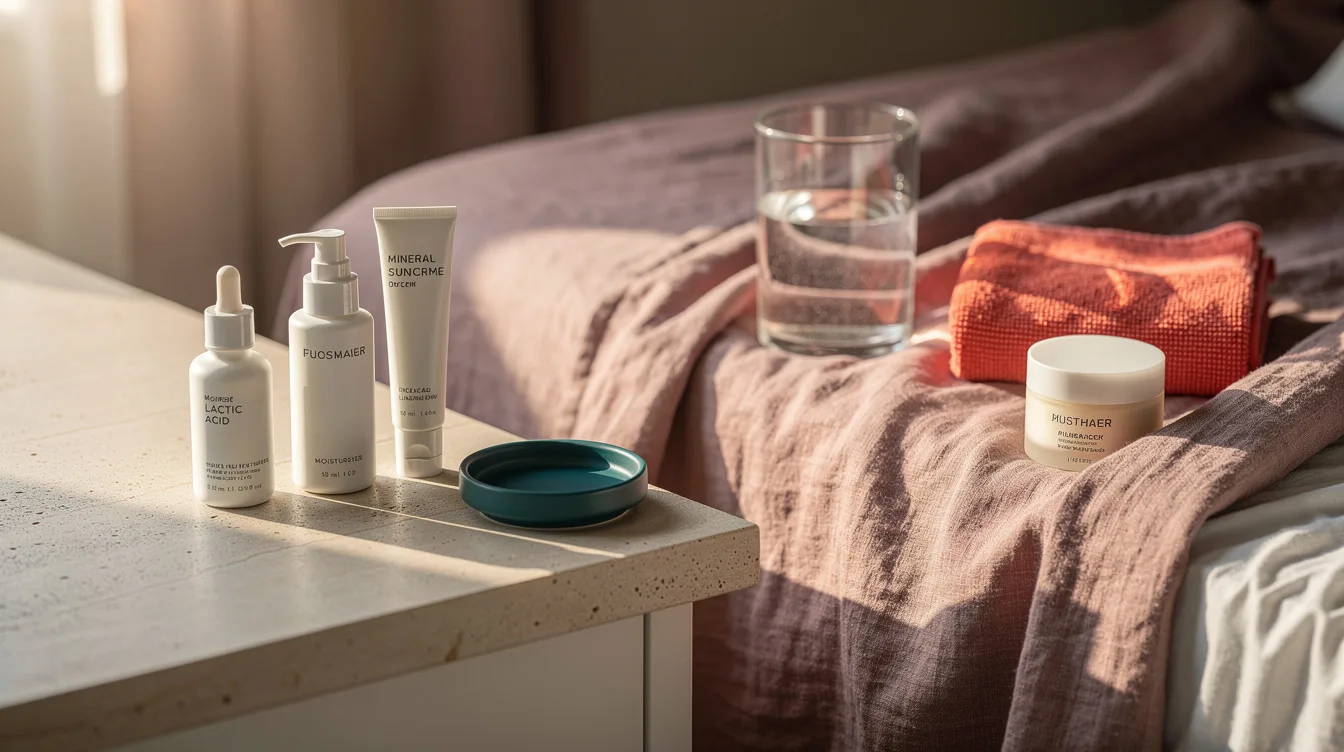
The mirror can make a once-reliable exfoliating pad feel like a bad bargain when your cheeks suddenly sting and your makeup catches on dry patches. For skin that feels thinner after menopause, a sensible starting schedule is once every 7 to 14 days, not a nightly push for smoother texture.
Lower estrogen is associated with less hydration, resilience, and collagen support, so the useful goal is comfortable, protected skin rather than a constantly polished surface.
What you will find inside
- 1. Start With Less Than the Label Suggests
- 2. Choose Lactic Acid Over a Rough Scrub
- 3. Keep Retinol and Acids on Separate Nights
- 4. Treat Stinging as a Stop Signal
- 5. Save Salicylic Acid for Actual Congestion
- 6. Protect the Results With Moisture and Sunscreen
1. Start With Less Than the Label Suggests
“Daily use” on an acid bottle is not a personal instruction, especially when skin feels papery or tight. Begin with a gentle PHA formula every 10 to 14 days, then hold that schedule long enough to see how your barrier responds.
Give the routine roughly four to six weeks before considering once-weekly use. Our view: consistency at a low frequency is far more useful than chasing a quick glow followed by peeling.

2. Choose Lactic Acid Over a Rough Scrub
A low-strength 5% lactic acid treatment is often a more sensible first AHA than a grainy facial scrub for dry, texture-focused skin. The Ordinary Lactic Acid 5% + HA is widely available online and is typically priced around $10, though even a mild acid can irritate.
Skip abrasive walnut-style scrubs, cleansing brushes, and vigorous washcloth rubbing when your face already feels fragile. Dermatologists generally favor mild chemical exfoliation or a very gentle cloth over physical friction for dry, sensitive skin.
3. Keep Retinol and Acids on Separate Nights
Retinol can be useful in a mature-skin routine, but pairing it with an exfoliating acid on the same evening often creates unnecessary dryness. Use your retinol on one night and reserve exfoliation for another, usually no more than once every one to two weeks at first.
That applies to over-the-counter options such as RoC Retinol Correxion products as well as prescription retinoids. If either step leaves persistent burning or flaking, pause the exfoliant and ask a dermatologist how to simplify the routine.
4. Treat Stinging as a Stop Signal
Stinging, ongoing redness, flakes, tightness, or a shiny over-polished look are signs to step back, not evidence that the product is working harder. Wash the product off if it is still on the skin, then return to a plain cleanser, moisturizer, and sunscreen routine until comfort is back.
A basic moisturizer such as CeraVe PM Facial Moisturizing Lotion, typically about $16, can help support the barrier after cleansing or on non-exfoliation nights. Moisturize immediately after exfoliating, and don’t add another active ingredient to “fix” irritation.
5. Save Salicylic Acid for Actual Congestion
Salicylic acid is useful when blackheads, oiliness, or chin and jawline breakouts are genuinely part of the picture, but it is not automatically the best choice for dry menopausal skin. A 0.5% to 2% BHA can be used once weekly and applied only to congested areas when the rest of the face is dry.
Paula’s Choice Skin Perfecting 2% BHA Liquid Exfoliant is a familiar option at Sephora and Amazon, but daily full-face use can be too much for reactive skin. Keep the frequency modest, especially if you are also using retinol or benzoyl peroxide.
6. Protect the Results With Moisture and Sunscreen
Exfoliation temporarily leaves skin more vulnerable to irritation from the rest of the routine and from daylight, so daily broad-spectrum SPF 30 matters more than adding a stronger acid. A generous moisturizer and sunscreen do more for a comfortable, even-looking finish than escalating from a 5% formula to a harsher one.
Hold off entirely during sunburn, cracking, open skin, active eczema, rosacea flares, or dermatitis. Anything that bleeds, changes shape, or does not heal deserves a dermatologist’s evaluation rather than another exfoliating product.
Start by putting one gentle exfoliation night on the calendar every other week, then protect that decision with a plain moisturizer and daily sunscreen. The total cost of a calmer routine can be lower, too, because you are less likely to buy products meant to soothe irritation created by overdoing it.