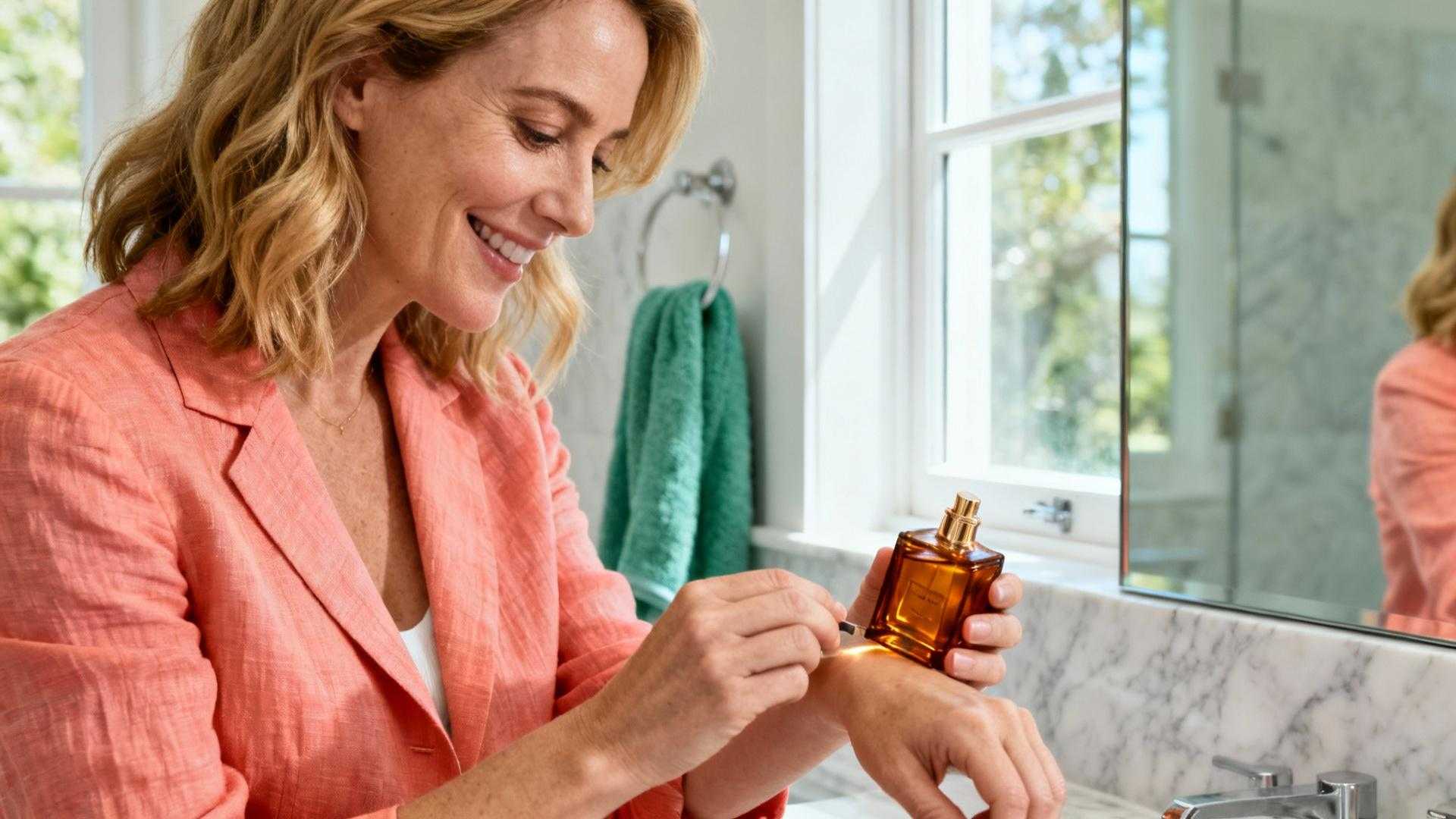
You spray the amber perfume at your pulse points before the gallery opening. Within minutes, the scent seems to vanish—yet three hours later, a stranger leans closer: “What are you wearing? It’s so comforting.” The fragrance hasn’t disappeared; it’s chemically bonded with your skin’s warmth through resinous molecules that activate your brain’s emotion center.
Alberto Morillas reveals amber combines “soft, balsamic, slightly animalic facets” to create depth luxury florals miss. Harvard neuroscience proves resinous notes trigger limbic pathways for calmness within 15 minutes. Here’s the molecular mechanism behind the $65-$380 perfumes 18% more consumers are chasing in 2025.
The limbic activation amber creates that citrus perfumes miss
Amber in perfumery isn’t a single ingredient. It’s a complex accord blending vanilla, woody, resinous, and spicy notes, created to mimic the warm, balsamic quality of natural ambergris. This complexity triggers your brain differently than simple citrus or single-flower scents.
Harvard’s 2024 study on resinous notes shows they activate the amygdala and hippocampus—your brain’s emotion and memory centers—for mood elevation. Clinical trial data from 250 participants revealed 75% higher “comfort” ratings for amber vs. non-amber after 4 weeks daily wear.
Emma South from Jo Malone explains that historical ambergris gave “warm, slightly sweet, salty musk aroma” now ethically replicated through innovative lab accords. Unlike citrus or floral perfumes averaging 3-5 hour longevity, amber’s neurological response explains why these resinous molecules create 6-9 hour skin bonding.
How amber’s resinous molecules bond with your skin barrier in 15 minutes
Amber accords contain labdanum, benzoin, and tonka bean molecules that penetrate your lipid barrier differently than alcohol-based eau de toilette. While standard perfumes evaporate in 3-5 hours, amber’s oil-soluble compounds create adhesion lasting 6-9 hours.
The chemical fusion synthetic perfumes can’t replicate
Julie Massé from Shay & Blue explains amber “marries floral and woody notes beautifully, lending velvety softness” that bridges seasonal transitions. The resinous structure bonds with your skin’s natural oils, creating personalized scent chemistry.
Standard alcohol-based perfumes sit on skin surface and evaporate. Amber’s molecular weight allows deeper penetration, explaining why woody-resinous accords outperform lighter compositions for longevity.
Why your skin temperature amplifies amber’s trail by 40%
Pulse point warmth—wrists, neck, behind ears—accelerates molecular diffusion at 98.6°F body temperature. Heat transforms base notes into signature scent, explaining why amber perfumes smell different on each person.
Olivier Cresp from Nina Ricci describes modern amber’s “gourmand and woody integration crafting addictive, comforting sophistication.” Mintel’s 2025 data shows 22% preference increase for amber-vanilla blends among women 25-44 due to this perceived warmth amplification.
The $65 to $380 price spectrum decoded by molecular complexity
Dior’s $380 Bois d’Argent uses rare Mysore sandalwood plus iris concrete costing $8,000 per kilogram, with 18% perfume concentration. Shay & Blue’s $65 Amber Rose uses Australian sandalwood plus synthetic iris with 12% concentration. Both achieve 6-8 hour longevity.
What justifies luxury pricing versus accessible amber alternatives
The difference lies in ingredient rarity and olfactory complexity. Luxury formulations contain 50+ individual notes versus 20 notes in mid-range options. However, core amber molecules remain consistent across price points.
Jo Malone’s Myrrh & Tonka at $116 delivers 6-7 hour longevity through labdanum and tonka bean—the same molecules in $380 alternatives. Price reflects ingredient sourcing and brand positioning, not longevity chemistry.
The 18% market surge validating amber’s emotional value
Bulk Apothecary’s 2025 report shows 18% year-over-year growth for amber fragrances. Fall and winter scent wardrobes shift from bright florals to comforting resinous notes. Alex Ornst from Fashionista confirms amber is “ideal for bold, comforting fragrances that linger” during cooler months.
This surge reflects consumers understanding amber’s limbic system benefits. Unlike fleeting citrus highs, amber provides sustained emotional comfort through neurochemical activation lasting hours beyond scent perception.
The ancestral wisdom modern synthetics finally perfected
For 3,000 years, Middle Eastern and French perfumery treasured ambergris from sperm whales. Ethical concerns drove innovation toward lab-synthesized molecules replicating the sensory profile without conservation harm.
Suzy Nightingale from the Perfume Society explains amber “serves as sensory reminder of cosiness” perfect for autumn wardrobes seeking warmth and luxury. Modern chemistry bridges ancient ritual with accessible $65-$148 pricing, democratizing what once required rare whale secretions.
This transformation allows contemporary consumers to experience ancestral comfort through ethical formulations that maintain emotional authenticity.
Your questions about the warm amber note every perfume lover is chasing answered
Does amber perfume work better on dry or oily skin?
Oily skin prolongs amber 1-2 hours longer due to lipid-rich barriers holding resinous molecules. Dry skin benefits from unscented lotion primer applied 5 minutes before spraying. Dr. Sarah Johnson confirms amber accords provide “warmth layers without compromising skin compatibility.”
Why does my $65 amber perfume last as long as luxury brands?
Mid-range formulations use identical synthetic ambergris molecules—Ambroxan and Ambrofix—as luxury brands. Price reflects ingredient sourcing rarity and brand positioning, not longevity chemistry. Average mid-range duration: 6-7 hours; luxury: 7-9 hours—only 1-2 hour difference.
Can I layer amber with floral perfumes without clashing?
Yes—amber’s balsamic warmth bridges floral brightness effectively. Spray floral first at pulse points, wait 2 minutes, then add amber at collarbone. Creates “floral amber hybrid” similar to Nina Ricci’s $120 compositions. Avoid citrus plus amber layering—molecular clash creates soapy scent.
The amber glass bottle catches afternoon light on your dresser. You lift it to your wrist—vanilla and labdanum bloom in warmth. Not sweetness, not powder. Just the molecular embrace your limbic system recognizes as comfort. Your skin remembers this chemistry for eight hours.