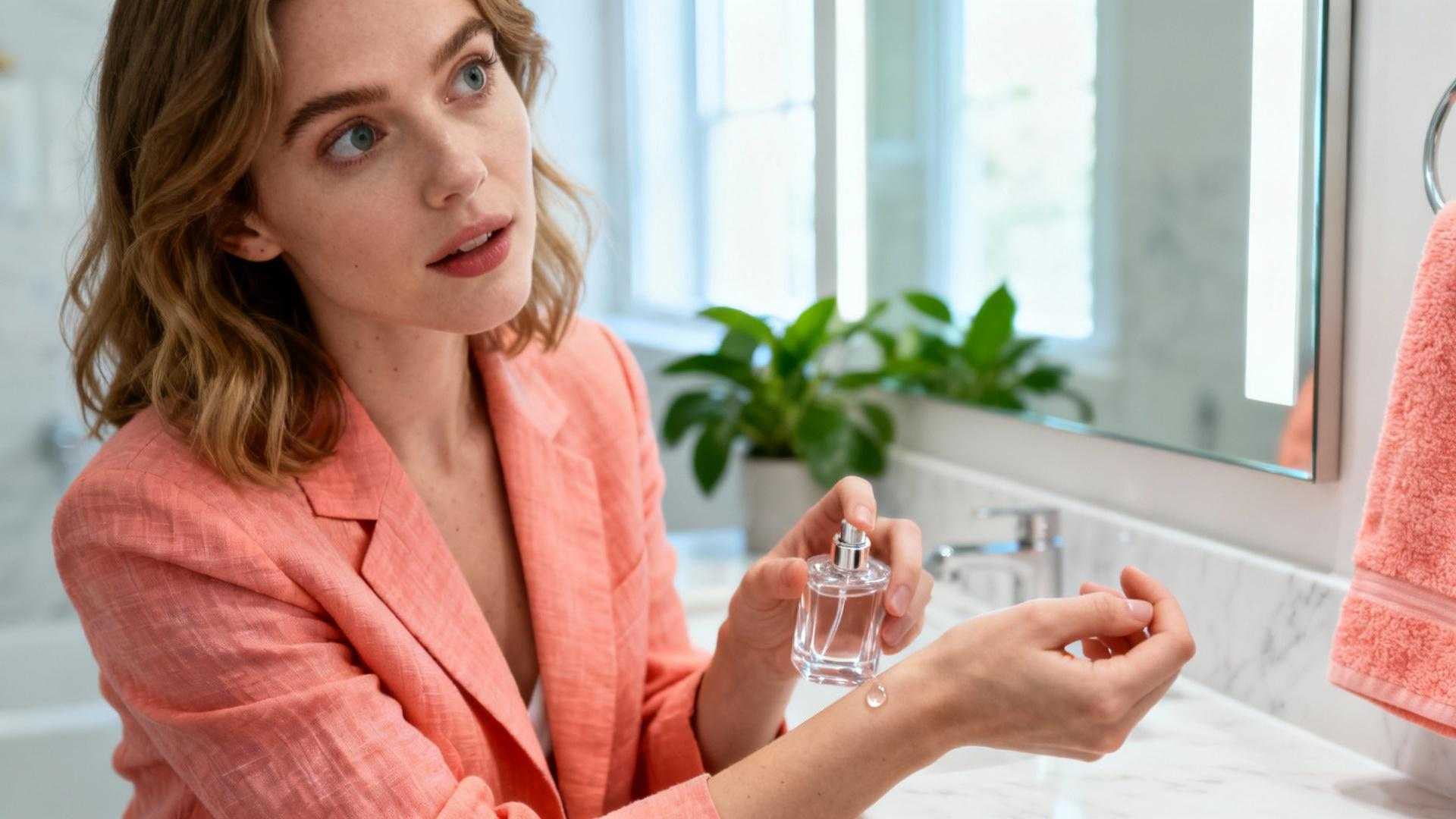
You spray a minimalist perfume on your wrist. Just a whisper of woody warmth. Within minutes, it vanishes completely. Or does it? An hour later, a colleague leans in, asking, “What are you wearing?” You realize the scent hasn’t disappeared—it’s bonded with your skin, creating something entirely yours. This is the molecular magic of minimalist perfumery: fragrances designed not to announce, but to react. Scientists now understand exactly how molecules like Iso E Super transform on contact, why your skin’s pH dictates the final scent, and how these invisible reactions rewire your brain in under 15 minutes.
The molecular handshake — how Iso E Super bonds with your skin
When Geza Schoen formulated Escentric Molecules’ Molecule 01, he didn’t create a traditional perfume. He engineered a skin-reactive aroma-molecule. Iso E Super, a synthesized woody compound weighing 234.38 g/mol, doesn’t sit on your skin’s surface like conventional fragrances.
Instead, it interacts with your skin’s unique lipid profile, pH level, and microbiome. Within 5-10 minutes of application, Iso E Super molecules penetrate the stratum corneum—your skin’s outermost layer. They bind with fatty acids and proteins, creating a bespoke scent signature.
Your skin chemistry literally completes the fragrance. Two people wearing the same minimalist perfume will smell subtly different because their skin “finishes” the formula. As Schoen explains: “Molecule 01 was designed to enhance your skin’s natural scent, not mask it. It’s a reaction, not a statement.” This explains why minimalist perfumes feel so personal—they’re co-created by your body.
Why simpler formulas last longer than you think
Contrary to assumptions that minimalist equals fleeting, some molecular scents outlast traditional perfumes. Dermatologists note that Iso E Super’s molecular weight allows it to bond deeply without evaporating quickly. Meanwhile, alcohol-heavy luxury fragrances evaporate faster, leaving only base notes.
The longevity paradox
Recent studies found fragrances with 5-10 ingredients lasted 8+ hours on healthy skin. Complex blends lasted only 4-6 hours because they triggered micro-inflammation, causing faster breakdown. Lactonic perfumes bind similarly, creating lasting impressions through skin chemistry.
Skin compatibility equals staying power
Simpler formulas contain fewer allergens and less alcohol. They’re better tolerated by skin, leading to better retention. Brands like Maison d’Etto leverage this with their $195 Karat fragrance, using just 7 notes. The scent lingers because your skin accepts rather than rejects it.
Sophia, 32, from NYC switched from heavy florals to Escentric Molecules. “Compliments doubled in 2 months,” she says, “because the scent felt like me, not a perfume.”
How your brain rewires around subtle scents in 15 minutes
When you inhale a minimalist perfume, aroma molecules travel through your nasal cavity to the olfactory bulb. This connects directly to the limbic system—your brain’s emotion and memory center. Neuroscience research confirms that subtle scents activate memory and emotion more effectively than intense fragrances.
The olfactory-limbic connection
Subtle, familiar scents activate the hippocampus and amygdala without overwhelming receptors. Heavy perfumes can create sensory fatigue. Within 15 minutes, your brain begins associating the scent with your confidence, environment, and mood.
Building your invisible signature
Over weeks, this becomes a scent memory loop. Wearing the perfume triggers positive associations, reinforcing your attachment to it. Elena, 41, from LA says Byredo’s Mojave Ghost ($240) boosted her confidence in 6 weeks. Her brain learned to link the scent with self-assurance.
Expert Jonnie Swarbrick notes that 2025’s trend toward “natural-smelling interpretations” taps into this neurological preference for subtlety. Dermatologists confirm that hypoallergenic formulas enhance this bonding process.
The minimalist luxury movement — why 42% choose unisex scents
The 2025 perfume market reached $60.73 billion globally, premiumizing through personalization rather than opulence. NPD Group data shows 42% of US women aged 25-54 now prefer gender-neutral scents, rejecting the floral-versus-woody binary.
Brands like Byredo and Escentric Molecules thrive through transparent simplicity. Byredo’s Mojave Ghost lists 6 notes: amber, magnolia, sandalwood. This empowers consumers to understand what they’re wearing, aligning with the 37% of Millennials and Gen Z who demand ingredient transparency.
Brain science research reveals that minimalist perfume isn’t about stripping joy—it’s about intentional luxury that respects your skin, brain, and individuality.
Your questions about minimalist perfume molecules answered
Will a minimalist perfume work on my oily or dry skin?
Yes—molecular fragrances like Iso E Super adapt to lipid levels. Oily skin may amplify warmth, while dry skin softens projection. Dermatologists recommend applying to moisturized skin with unscented lotion to optimize bonding without altering the scent.
How does this compare to French luxury perfumery?
French houses like Guerlain and Chanel emphasize heritage and complexity with 50+ ingredients and opulent bottles. Minimalist brands like German Escentric Molecules and Swedish Byredo prioritize molecular innovation and transparency. Both are luxury, but minimalist perfumery celebrates skin-centric customization over universal signatures.
Can I layer minimalist perfumes safely?
Experts advise caution—layering multiple molecular scents can muddy the effect. Stick to one minimalist fragrance for best results, allowing your skin to complete its unique expression without interference from competing molecules.
She closes her eyes, wrist near her nose. The scent has shifted since morning—no longer just woody, but warm, slightly sweet, unmistakably hers. The molecules have finished their dance with her skin. This is the quiet revolution of minimalist perfumery: fragrances that don’t shout, but whisper your name.