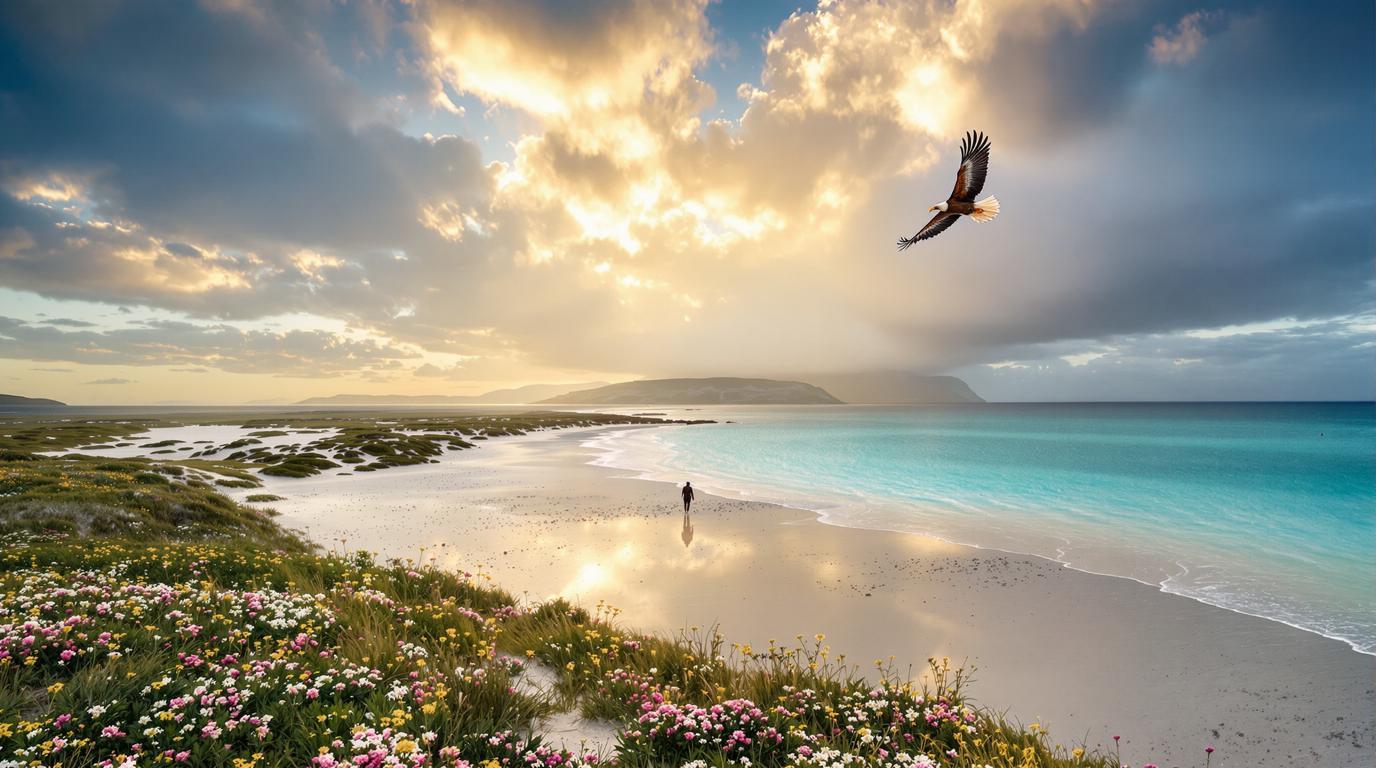
The wild Atlantic winds sweep across the rugged shoreline of North Uist, a mesmerizing island where land and water exist in perfect equilibrium. With 90% of its western coast lined with pristine white-sand beaches, this Outer Hebridean gem remains one of Scotland’s best-kept secrets. Unlike the tourist-heavy Isle of Skye, North Uist offers something increasingly rare in modern travel: genuine solitude among breathtaking natural beauty.
Where eagles soar above a patchwork landscape
North Uist’s unique geography creates a stunning visual tapestry that changes with every mile. The eastern side features rocky hills and peat bogs, while the western coast transforms into the machair – a rare, flower-rich grassland that bursts into a riot of color during summer months. Golden eagles and hen harriers circle overhead, scanning the mosaic of freshwater lochs that dot the island.
“Our island breathes with the rhythm of two worlds,” explains local crofter Angus MacDonald. “The saltwater Atlantic on one side, hundreds of freshwater lochs on the other. We live between them, just as our ancestors have for thousands of years.”
The archaeological treasure trove few travelers discover
History enthusiasts will be enthralled by North Uist’s ancient monuments. The 5,000-year-old Barpa Langass chambered cairn and the haunting stone circle at Pobull Fhinn speak to the island’s prehistoric significance. Much like America’s ancient maritime civilizations, these sites reveal how early communities thrived in seemingly harsh coastal environments.
A paradise for wildlife enthusiasts and bird watchers
The RSPB nature reserve at Balranald offers world-class bird watching opportunities. During summer, listen for the distinctive crex-crex call of the rare corncrake. Otters play along the shoreline, while offshore, lucky visitors might spot minke whales or dolphins. The biodiversity rivals Australia’s wildlife sanctuaries, yet remains wonderfully uncrowded.
Beaches that rival the Caribbean (minus the crowds)
Traigh Iar and Hosta Beach offer Caribbean-quality white sand and turquoise waters – with one key difference: you’ll likely have them entirely to yourself. The machair backing these beaches creates a vibrant natural garden of wildflowers during summer months. Unlike Thailand’s seasonal beach paradises, North Uist’s coastal beauty maintains its wild character year-round.
The unexpected gin renaissance
The North Uist Distillery has spearheaded a craft spirits revolution on the island. Their award-winning Downpour Gin incorporates local botanicals like heather and sea kelp, creating a spirit that literally captures the island’s essence. Visit their tasting room to sample spirits that tell the story of this remarkable landscape.
“We wanted to bottle what makes North Uist special,” says Kate MacDonald, co-founder of the distillery. “The freshness of the air, the purity of the water, the wildness of the Atlantic – it’s all there in the glass.”
A living Gaelic culture
Unlike many parts of Scotland where Gaelic is merely a historical footnote, North Uist maintains a vibrant Gaelic-speaking community. Summer ceilidhs (traditional gatherings with music and dance) welcome visitors to experience authentic Highland culture. The climate here may not match Spain’s year-round sunshine, but the warmth of local hospitality more than compensates.
Conservation in action
North Uist demonstrates how tourism and conservation can coexist harmoniously. The island’s approach to protecting its natural heritage mirrors the principles found in Thailand’s elephant sanctuaries, emphasizing sustainable visitor experiences that benefit local ecosystems and communities.
To truly understand North Uist’s magic, you must experience its ever-changing light. As the sun breaks through rain clouds, illuminating patches of machair, beach, and loch in a celestial spotlight, you’ll understand why artists and photographers are drawn here. This remote Atlantic outpost isn’t merely a destination – it’s a reminder of what we seek in travel: not just Instagram-worthy views, but genuine connection with landscapes and communities that exist on their own terms, unchanged by tourism’s homogenizing influence.